- Pigtails, A Painter, and A Gypsy -
Return to Home Page Return to Journey Together
Most children love to go to camp. A few become smitten with home-sickness,
while others thrive hysterically on the heightened scene of endless activity,
next-to-nature living, and to ‘Mom’s Away’ choices to make. These choices
usually involve eating, baths, changes of clothing (or not), and ‘spending it all’
for crafts and candy.
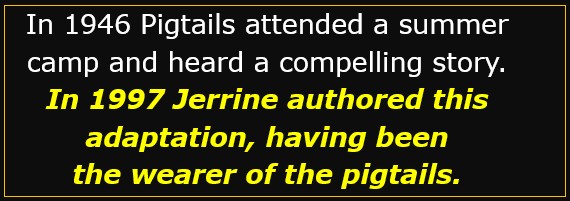
Pigtails, a 12-year-old sixth-grader, ‘hit’ the camp trails with all the enthusiasm
and energy she could possibly unleash. Life in an apartment in a large city
had prepared her for the welcome change to life in the out-of-doors. The
perpetual pace was her ‘cup of tea’, and no time was lost in racing to the first
assigned activity!
The days zoomed by with no timeouts; just raw fun, free for the taking. Pesky experiences like sore throats, bouts
with mosquitos, and poison ivy were hardly noticed. The anticipated Saturday Evening Campfire was
announced for the hill-top and campers fairly flew up the trail at the sound of the bugle.
Pigtails was among the first to arrive. She was short and selected a spot near
the front, anxiously waiting for the stragglers to ‘finally’ come. One song and
then another was announced and sounds of laughter and harmony echoed
down the quieted trails and upward through the sparks that paved their own
pathways into the shadowy skies.
The head-leader rose and walked to the front. She told the group of girls that
she had brought a true story to share. Pigtails settled into a relaxed
comfortable position, glad that she was situated near the front where she could
‘hear and see it all’. Stories were her ‘absolutist’ most favorite thing--especially by a good ‘teller’. She
listened with rapt attention as the story began.
“Some years ago, there was a very fine painter who lived in the city of Dusseldorf, Germany. One day, an abrupt
knock at the door of his studio announced the arrival of a priest from the nearby Cathedral. He had brought with
him a request for a new altar-piece to be painted for the front of the church. It was to be of the Crucifixion.
The artist told him that such a painting would be very expensive, but soon the amount of purchase was agreed upon,
as well as a date for the priest to return for the finished painting.
Almost immediately, the artist began to carefully plan the layout of the crucifixion painting. He was able to
proceed quickly through the preliminaries for such a sizeable project. Soon he began painting at a surprisingly
steady pace. The central figure of Christ on the cross took shape easily as did the sketches of the great crowd
around the foot of the cross surrounded by groups of people out on the fringes of the scene, some of whom were
women. As the artist began to fill in the detail of each individual, his pace slackened. It seemed that he could
not complete any of the faces of the crowd, not even one. The artist was troubled. Somehow, within his own mind,
he lacked a clear image of the facial features and feelings expressed by the people gathered at the mob scene. The
project came to a complete halt. Tucking his sketch pad under his arm, the artist chose to ‘escape’ from the
burdensome project to the nearby woods of the Black Forest. Time and again, he had found this spot of beauty to be
a fitting place of ‘retreat’ when his own soul thirsted for inspiration and renewal.
As he trod on the well-worn paths and stomped down some new ones as well, he happened upon a young gypsy girl
dancing in the sun. When she noticed the ‘visitor’, she cleverly quickened the rhythmic patterns of her movements.
Soon her faded and tattered dress became a maize of swirling color accented by the intermittent sounds of snapping
fingers and stomping feet. Instinctively grabbing his pencil, the artist sketched her perfectly posed body. Her
ragged appearance was an obvious contrast to the distinct beauty of her graceful form and fine features profiled
in the glistening sunlight. The artist was overjoyed to find what a truly perfect subject he had discovered, and
he desired to paint her as a dancing gypsy girl. He arranged for ‘Pepita’ to come to his studio one day each week
to model for him.
On the right day, and at just the right hour, Pepita climbed the rickety steps and knocked softly at the
well-worn door of the artist’s studio. She was beckoned inside and immediately directed to the place where she
was to pose. As she took her position, she glanced across the room at the partially finished painting propped
against the wall in the far corner. Pepita had never seen such a painting and she was troubled by it. Curious
questions began racing in her mind concerning it, but when she saw the artist fervently bent upon his work, she
knew she dared not interrupt him. For now, she must keep her questions to herself.
As the young gypsy girl continued to come for her sittings, she found herself increasingly drawn to the
‘mysterious’ painting. Finally, one day, she could not contain herself any longer. At what seemed to her to be the
‘right moment’, she asked who the person on the cross was, and what was being done to him!
The artist went right on with his work, but mumbled a terse response. “Oh,” he said, “the name of the man on the
cross is Jesus, and the crowd and the soldiers are crucifying Him. That kind of death was a common custom of the
day to eliminate lawbreakers. Now hold still, Pepita. I do not pay you to ask questions, but to sit still!”.
At the next visit to the artist’s studio, Pepita gazed again at the unfinished painting, which by now had etched
its way into her mind rather permanently. As soon as she dared, she offered a comment about what a bad man Jesus
must have been.
The artist’s response came very quickly as he continued to ‘ready’ his pallet and brushes for the day’s work. “No,
Pepita, that’s not so. Actually, Jesus was a very good man.” “Oh,” said the gypsy, “Then the people in the picture
must be very bad.”
Obviously annoyed at the continuing interest of Pepita in the painting, the artist unhappily explained that there
were many different groups of people represented in the picture and that the soldiers and many others in the crowd
believed that they were doing the ‘right thing’ in crucifying Him.
Pepita was even more distraught. She continued to question the purpose for such a death if Jesus was really a good
man.
The artist became exasperated and set his brushes aside. He decided to explain the whole story of the crucifixion
to her if she would promise never to ask any more questions. In a voice completely void of any emotion, the artist
told her that God who lived in heaven loved the people on earth that He had made. He placed Adam and Eve in a
garden that was perfect and beautiful. They chose to disobey Him and as a result, they lost their position and
brought on themselves the penalty of death and separation from God. Now all the rest of mankind would be in the
same dilemma. But God could not bear to see His children separated and hopelessly ‘lost’ forever. For centuries,
He promised to send One who would bring salvation to the earth. Meanwhile, He had provided a temporary way for
people to be forgiven and have peace with God. Finally, the Promised One came and it turned out to be this Jesus,
who was really God’s own Son. He entered the earth as a baby born in Bethlehem and angels sang to some shepherds
to announce His arrival. When He grew up, He demonstrated that He really was God’s Son by healing the sick, giving
sight to the blind, and helping everyone who came to Him. He taught people thatthey should repent, and God would
forgive their sins and give them the gift of eternal life. He had so many followers that the Priests of that day
were very jealous, and made false charges against Him to the government in power. They stirred up the people and
demanded that He be put to death. Jesus willingly allowed Himself to be mistreated and suffer the cross-death,
because it was really a part of God the Father’s plan from the beginning. Jesus had been chosen to bear the
penalty for the world’s sin ever since Adam’s time. He was the only One who could do that because He was perfect
and without sin Himself. Then there could be restoration and peace between man and God.
The artist breathed a sigh of relief and picked up his palette to begin the careful mixing of colors he needed to
continue his work. As he looked up to check Pepita’s position before brushing on the next stroke, he was stunned
and dismayed to see that tears were running down the face of the young gypsy maiden.
“Now, what is wrong, Pepita? I have told you the entire story. There is no more. Why are you crying?” the artist
barked.
Pepita said, hesitantly, “You must love Him very much when He’s done all that for you.”
The words ‘stabbed’ the artist’s heart. For a long moment, he sat motionless. Then quickly he tried to ‘shortcut’
the task he had purposed to do that day and was only too glad to send Pepita out the door early. Once she was
gone, he was sure that those ‘stabbing words’ would go away.
That night and all the next day, the distraught artist had trouble sleeping. Over
and over, Pepita’s words echoed and reechoed in his mind. He reasoned to
himself that if he finished the painting of the crucifixion and removed it from his
studio, his peace of mind would return. The artist set about to work steadily on
the painting until it was complete.
Returning to his studio with the payment from the priest in hand brought a
satisfaction to the artist, but not the peace he had anticipated. The words,
“You must love Him very much when He’s done all that for you”, continued to
haunt him. He had never really thought seriously about the crucifixion before.
In desperation, the painter looked in the newspaper and located a small church
on the edge of town where services were being held. There were special
meetings that week and the artist attended them several nights in a row. As he listened to the gospel,
his heart was stricken with his own need for repentance and peace with God.
At the close of one of the services, the artist went forward to pray with the
pastor for the forgiveness of his sins and to offer thanksgiving for Jesus who
had died on the cross for Him. He returned to his studio with a new love born
in his heart for the One who had become his sin-bearer.
As the days passed, the artist thought about what he might do to express his
gratitude to God. He decided he would do another painting of the crucifixion.
Only this time, the face of Christ would be full of love and tenderness in place
of the stark agony shone in the first one. He worked arduously at his task and
when he finished, he gave the painting to the Dusseldorf Museum with this
inscription: “All this I did for you, what have you done for me?”
The story-teller finished and sat down next to the campfire, whose ‘boisterous’ flames had by now dissolved into
heaps of soft-glowing coals. The last song was sung, and in a flash, the trails were bulging with ‘cabin-bound’
campers with flashlights swinging at their sides, still singing as they went.
Pigtails was in a ‘world-of-her-own’ thought-mode as she too found her way down the trail that night. The poignant
question posed by the gypsy peasant, and now repeated on the new painting, had penetrated Pigtail’s limited
understanding of the cross-death and personalized its meaning. She had always known from attending Sunday School
that Jesus died ‘for the world’. Now, she knew that it was not only for the world, but also ‘for her’!
Stumbling around in the darkness, Pigtails located her Cabin-leader and shared with her the desire she had to have
her sin-debt taken care of by God. Following prayer with her counselor, Pigtails returned to her cabin, confident
that she had been forgiven and that the gift of eternal life from God was now hers. The scripture her counselor
pointed out would mark the occasion for the rest of her life. It is found in John 10:28. “And I give unto you
eternal life and you shall never perish, neither shall any man pluck you out of My hand.” While the campfire story
was over for most of the listeners, it was the story of a new beginning for Pigtails.